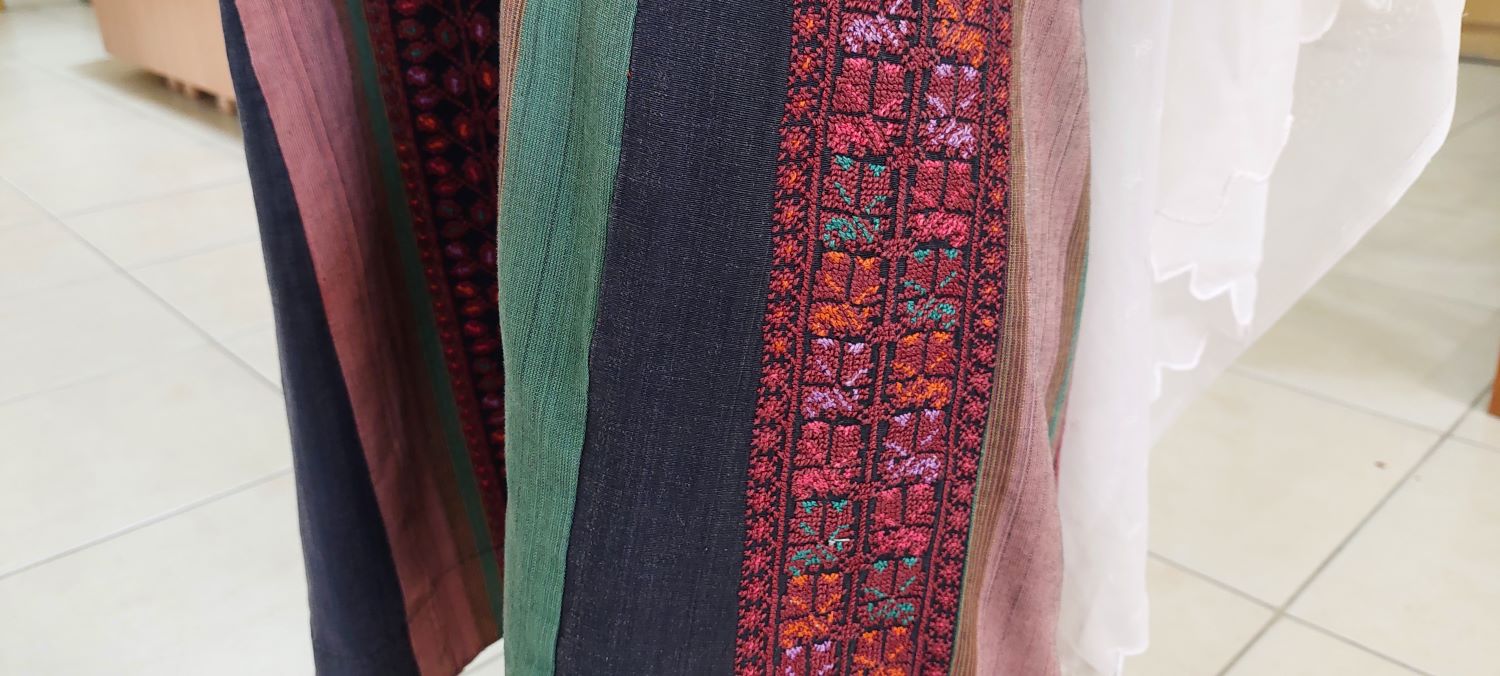
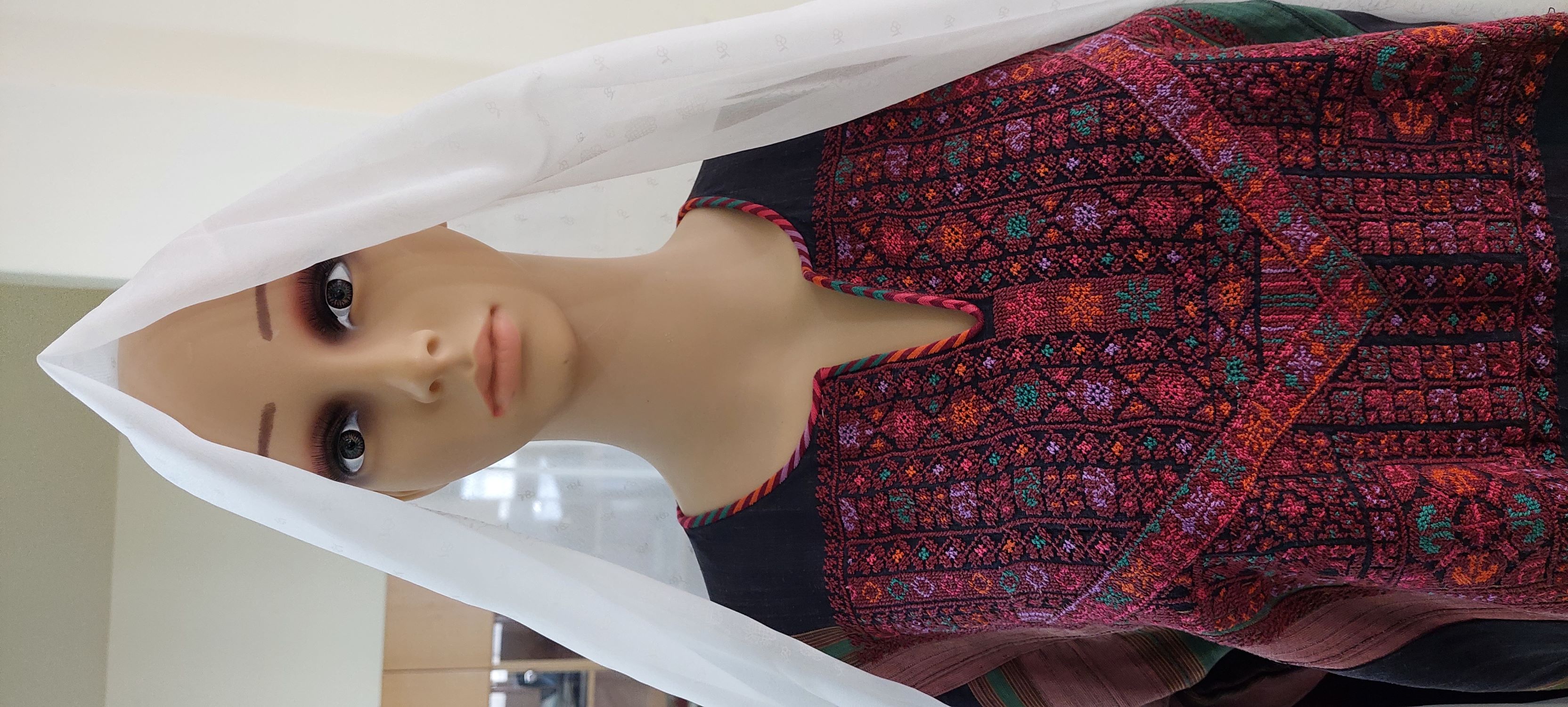
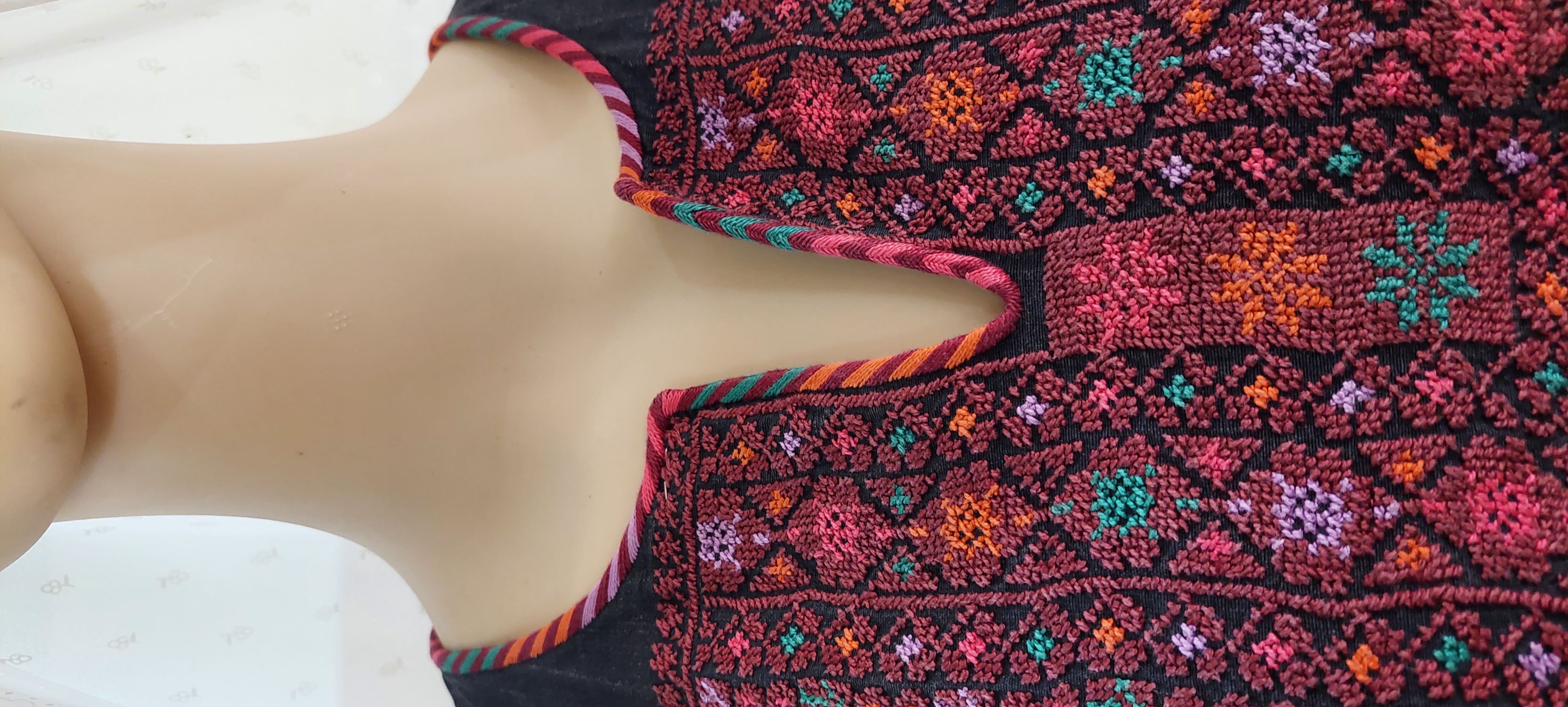
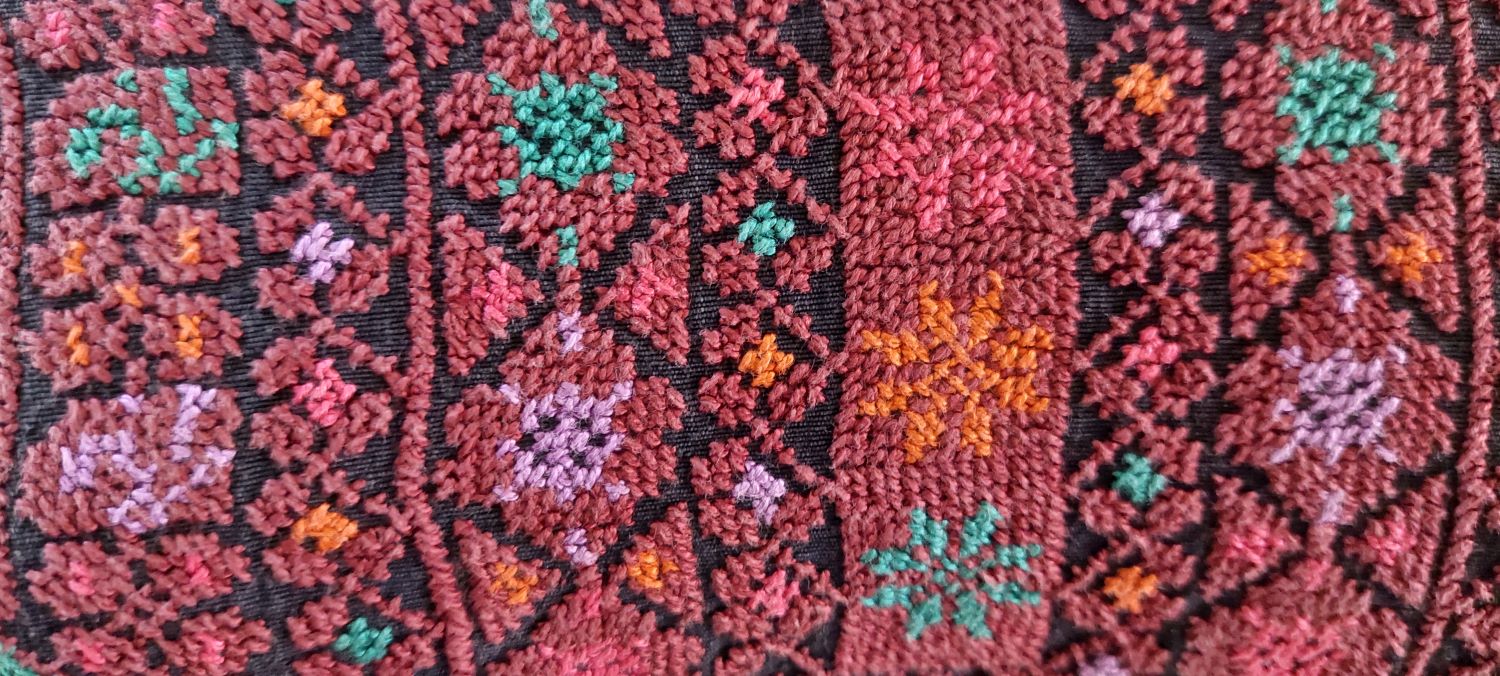
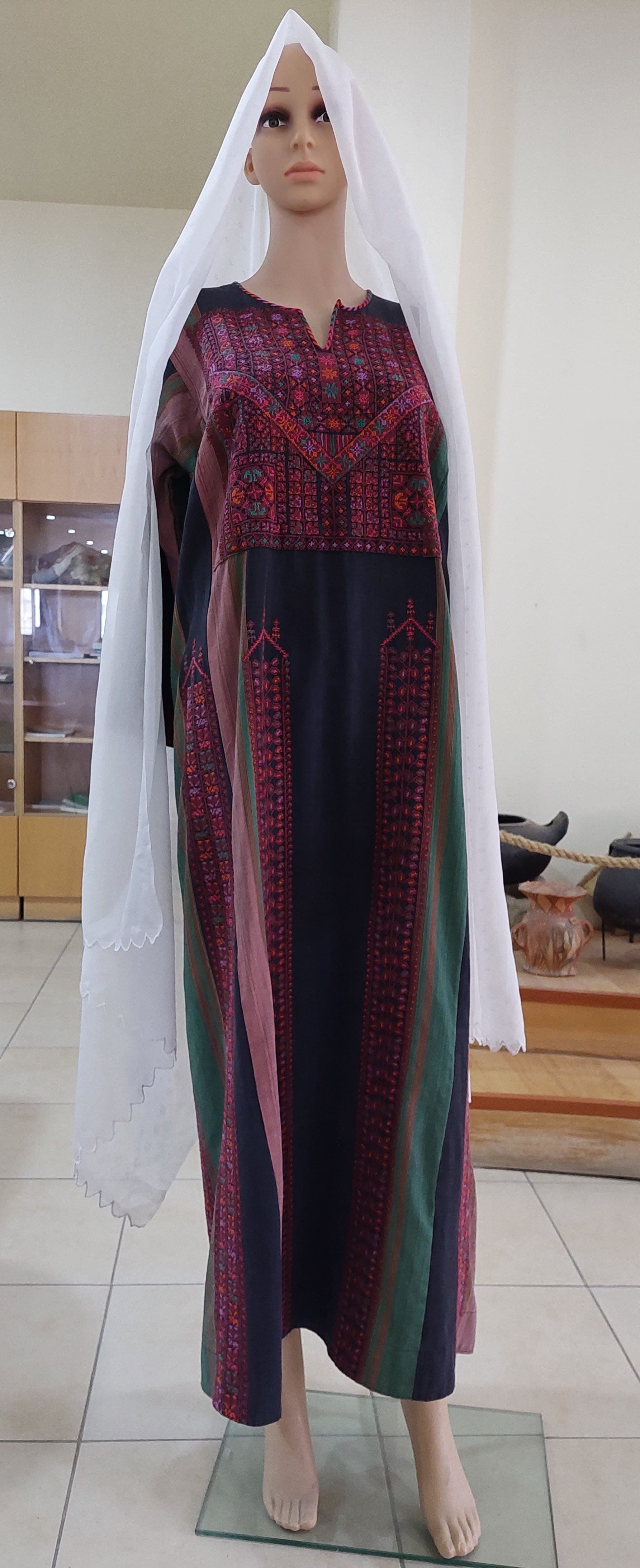
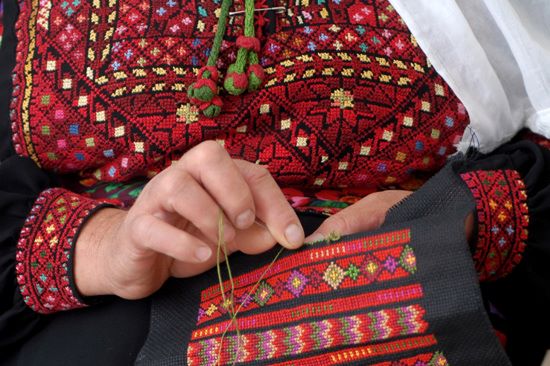
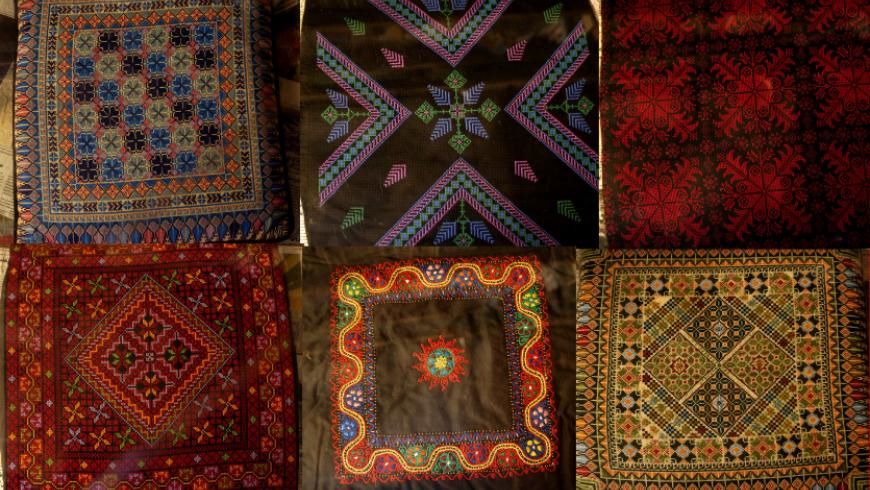
Embroidery is the art of decorating fabric using needles and thread, sometimes adorned with beads, shells, and coins. Embroidery has been associated with rural Palestinian areas and Bedouin regions in the Negev, often used to embellish the clothing of peasant and Bedouin women. This includes dresses, cloaks, pants, and head coverings such as qoqa, ʿiraqiyya, shattweh, burqa, and Bedouin veils. Embroidery typically adorned the chest area, including the neckline, shoulders, sides, and sleeves of the garment. Each region distinguished itself with a unique design style. It's noteworthy that the oldest archaeological evidence of colored women's clothing in Palestine was discovered in the tombs of Bani Hasan in Egypt, belonging to a Canaanite caravan on its way to Egypt in the second millennium BCE, featuring vibrant colors.
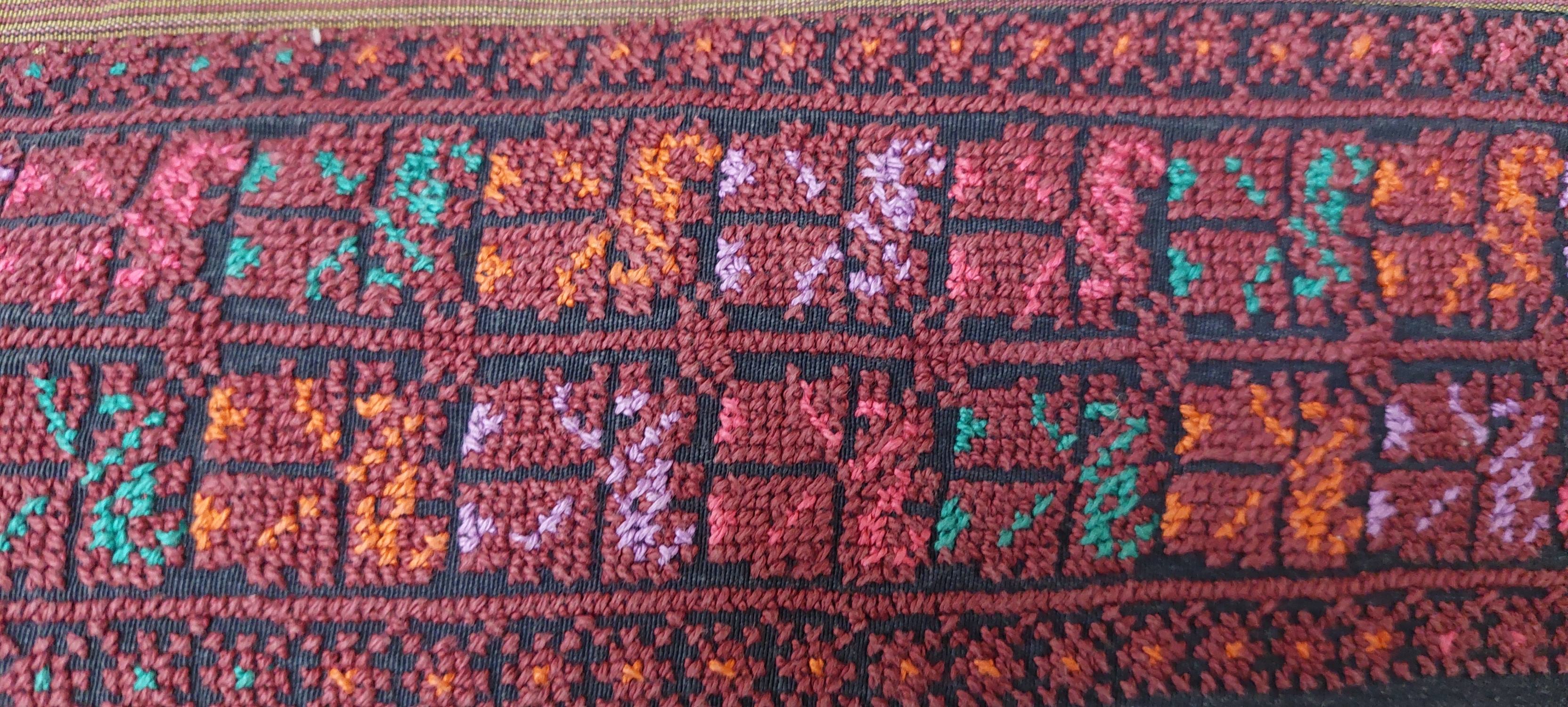
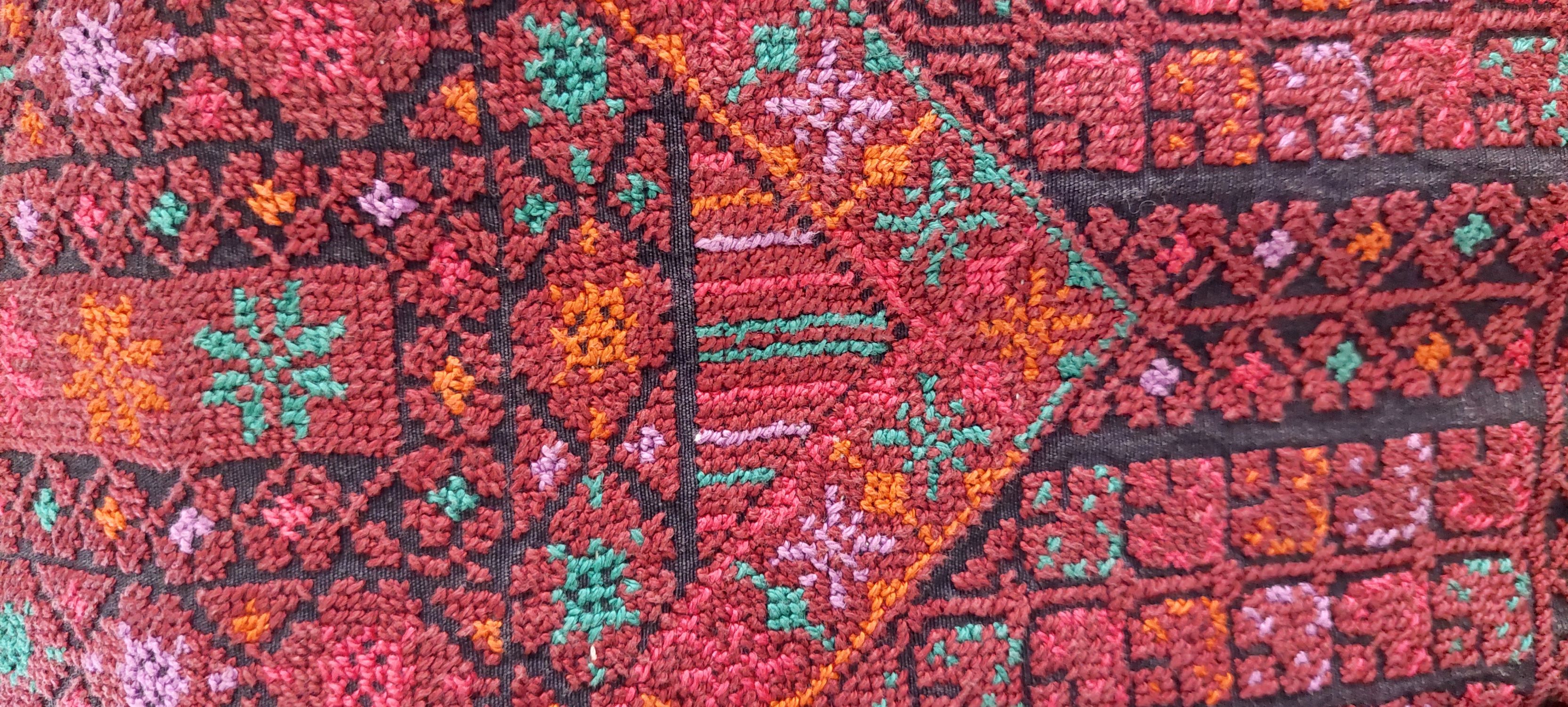
The cross-stitch, known as al-qubba al-fallaḥiyya, became the most widely used and associated with Palestine, especially in the late 19th century. Embroidery underwent changes in its patterns, themes, designs, and colors over time due to social and economic changes. Silk, gold, and silver threads were used in embroidery on locally handwoven fabrics, interspersed with cotton, linen, silk imported from Egypt, Syria, and England. Some cotton and wool fabrics were locally produced in Majdal, Gaza, Nazareth, Bethlehem, and Beit Jala. Fabrics and threads were often dyed using natural dyes extracted from plants and materials such as indigo, madder, and cochineal. Designs evolved in the 19th century from abstract geometric shapes to intricate forms like parallelograms, eight-pointed stars, squares, and intricate patterns inspired by local plants and animals such as cypress trees, palm trees, grapevines, and pomegranates.
Political and economic changes during the British Mandate influenced Palestinian embroidery, with the widespread import of high-quality European fabrics made of cotton, silk, and velvet, leading to a decline in local fabric production. Fine cotton threads, such as those produced by the French company DMC, entered the Palestinian market in the 1920s and quickly became more popular than Syrian silk threads. These cotton threads introduced new colors to Palestinian embroidery, and during this period, more complex forms, such as jars, human figures, and birds, became prevalent in cross-stitch.
Regional distinctions in embroidered clothing were evident in the type of embroidery, its themes, design coordination, thread colors, fabrics, and garment styles, showcasing the richness and diversity of this heritage. Bethlehem and Hebron were renowned for their use of "liberation embroidery," a technique allowing the creation of curved patterns using reed threads in the form of plants and other illustrative designs. Other embroidery techniques included tashreeem and tarqeeʿ, which involved adding fabrics to the original cloth, needle weaving, and qitaan, a weaving technique using silk, cotton, or other materials woven into fine cords.
Clothes available from the early 20th century provide evidence of the use of chain stitch, satin stitch, blanket stitch, fishbone stitch, and loop stitch, among other stitches. Some garments and cloaks from the Tira region in the Galilee were adorned with beautiful flower designs embroidered with red and blue threads on white cotton clothing. The precision and intricacy of embroidery were particularly evident in Bethlehem, Hebron, and Ramallah. Often, garments, head coverings, hats, and vests in these regions were covered with beautifully embroidered patterns rich in various stitches, with cross-stitch being the predominant one. Bethlehem was famous for its liberation embroidery, often using gold or silver threads to decorate garments and velvet jackets with rich floral or decorative designs.
After the Nakba in 1948, Palestinian women carried the tradition of embroidery to the diaspora, preserving it as part of the cultural identity of the Palestinian people. It became a symbol for the Palestinian people in both Palestine and the diaspora, featuring the colors of the Palestinian flag and the map of Palestine. In 2021, Palestinian embroidery was inscribed as "The Art of Palestinian Embroidery: Practices, Skills, Knowledge, and Rituals" on the UNESCO List of Intangible Cultural Heritage at the 19th conference in Paris.
Historical material extracted from an article by Diana Abu Ali titled "Palestinian Embroidery: National and Diverse Heritage." Interactive Encyclopedia of the Palestinian Issue, Palestinian Studies Foundation, Palestinian Museum. Accessed on December 20, 2023.