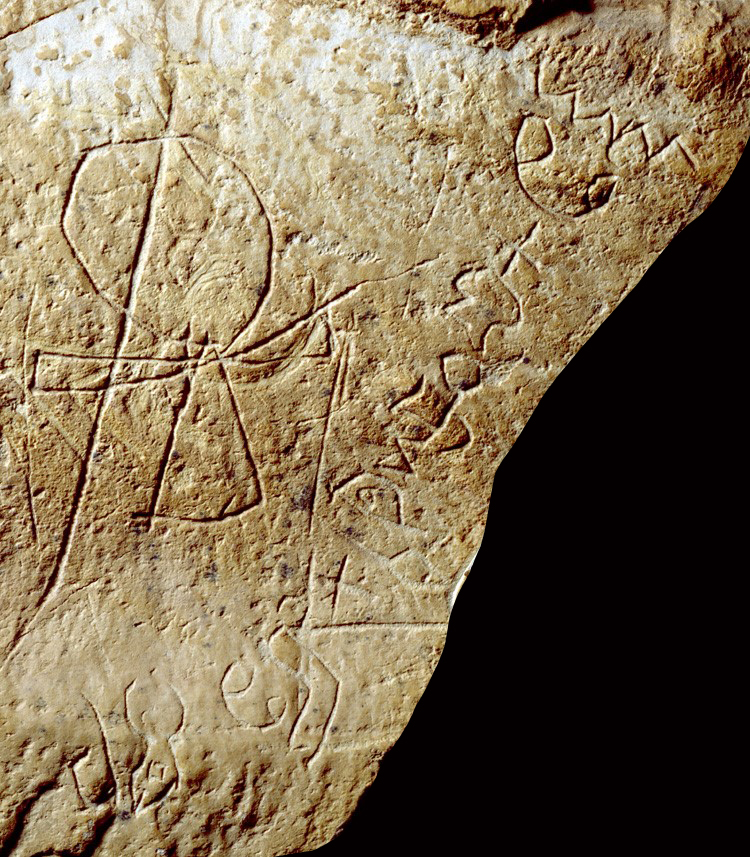
The Canaanite alphabet is a pictorial and then alphabetic script that originated in the 19th century BCE, represented in the inscriptions of Wadi el-Hol (El-Hol Valley) in central Egypt, the Sinai inscriptions, and scattered inscriptions in Palestine. It is directly derived from Egyptian hieroglyphs. The two Wadi el-Hol inscriptions (1 and 2) were discovered in 1993 on the same rock cliff, approximately one meter above the ground, with a distance of about 1.2 meters between them. The two inscriptions are dated to the period between 1900-1850 BCE, based on adjacent hieroglyphic and hieratic inscriptions. They were inscribed by Canaanite workers and soldiers working in Egyptian mining expeditions in Wadi el-Hol. These inscriptions are among the oldest Canaanite inscriptions discovered to date, dating back to the reign of Pharaoh Amenemhat I (1831-1806 BCE), and they contain 12 and 16 individual signs, respectively. They represent the oldest discovered alphabet inscriptions. The texts are written from right to left in both vertical and horizontal directions in ancient Canaanite (Sinaitic) script. The inscriptions are read as a single text, starting from the second inscription (Wadi el-Hol 2) and continuing to the first inscription (Wadi el-Hol 1). The script of the Wadi el-Hol inscriptions is similar to the Canaanite inscriptions from the Sinai site of Serabit el-Khadem, but the Wadi el-Hol inscriptions show a greater influence of hieroglyphic writing.
As for the Sinai inscriptions, they consist of two sets of stone inscriptions. The first set was discovered by the archaeologist Flinders Petrie in 1904 during his excavations at the temple of the Egyptian goddess Hathor in the Serabit el-Khadem site in Sinai. It consists of two groups: the first has 16 signs, and the second, discovered in 1935, has 34 signs. These inscriptions were considered a link between hieroglyphic pictorial writing and the Canaanite alphabet. They were written by Canaanite workers in the copper and turquoise mines in Sinai under the supervision of the Pharaohs. The script consists of 23 symbols, showing similarities to Egyptian hieroglyphic writing but adopting an alphabetic principle (acrophony), extracting the initial part of the shape of a written object and using it to represent the corresponding sound wherever it occurs. For example, using the head shape as a symbol for the letter "r" or using the house shape as a symbol for the letter "b." The language of these inscriptions is North Semitic (Canaanite), and their content is mostly votive inscriptions dedicated to the Canaanite sky god Baal, equivalent to the Egyptian goddess Hathor, for whom a temple was found at the site where these inscriptions were discovered. These inscriptions indicate the depth of cultural exchange between Egypt and Canaan.